UMD students and faculty posing with a local accessibility activist partner in summer 2023.
Image Credit: Mary Christensen
“Landscape is part of the land, as perceived by local people or visitors, which evolves through time as a result of being acted upon by natural forces and human beings… The landscape is a key element of individual and social well-being… and its protection, management, and design entail rights and responsibilities for all.”-Council of Europe Landscape Convention (2000)
At the University of Maryland’s College of Agriculture and Natural Resources, landscape architecture students and faculty are reimagining how communities can heal, connect, and thrive through the landscapes that surround them. Led by Dr. Deni Ruggeri, Associate Professor of Landscape Architecture, and Mary Christensen (MLA) of the Institute of Applied Agriculture, the Solidarity Landscape Living Lab is an ongoing international effort positioning the landscape as an active agent of solidarity, inclusion, and ecological renewal.
The Living Lab is guided by the principles of landscape democracy and by the Council of Europe definition of landscape above. It connects education, participatory action research, and community partnerships to invite people to rethink their relationship with the landscape. The project bridges university learning with community members lived experiences through annual on-site community workshops, fieldwork, and collaboration, co-creating meaningful change locally and abroad.
Challenges in the Landscape: A Region in Transition
The Living Lab focuses on the landscapes of the Po Valley in northern Italy, where urbanization, industrial agriculture, and environmental challenges have reshaped ecosystems and communities for centuries. Though this landscape was once rich in forest and wetland ecologies, the region’s ecological matrix is now marked by fragmentation, polluted waterways, and a lack of biodiversity due to decades of rapid economic and infrastructural growth.
The area faces pressing social challenges, including an aging population, the depopulation of rural communities, and the marginalization of vulnerable groups, including migrants, people with disabilities, and those facing economic hardship. These pressures have weakened the bonds between people and their surrounding landscapes, eroding not only ecological systems but also social cohesion and a sense of belonging.
The Solidarity Living Lab reframes the landscape as a platform for social innovation to respond to these overlapping crises, and as a place where stewardship for the land and care for people can reinforce each other. As one UMD student participant said,
“Solidarity landscape is the idea that landscape is the backbone for human connection. We may each live in separate buildings, but the landscape provides us with a familiar space of unity. At its core, it invites conversation, gathering, and activity, and is something we can all appreciate as human beings.”
The Lab employs education, co-creation, and participatory action research to reimagine new futures where urban growth, ecology, and solidarity can coexist in a more resilient landscape.
Designing with Solidarity: The Villaggio Solidale Project (Summer 2025)
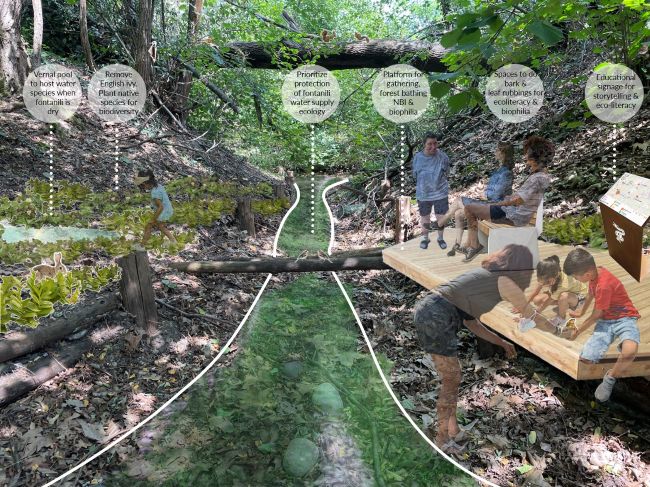
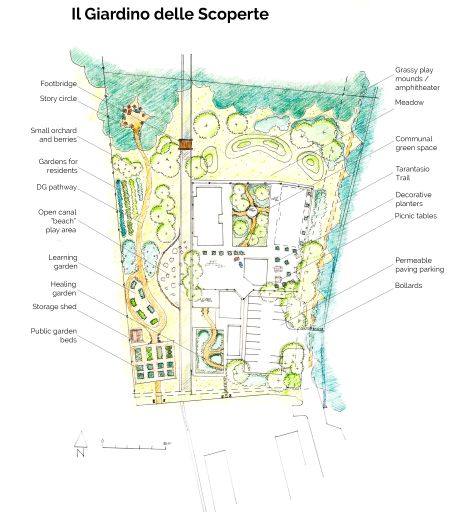
The 2025 Summer Workshop took place at Villaggio Solidale, a social-housing community in Lurano, Italy, dedicated to supporting its residents as they learn skills and rebuild their lives after hardship. This year’s workshop represented a major milestone for the fieldwork and design practice of the Living Lab as UMD students collaborated with their European partners to co-design a landscape expansion plan that reconnects the community to the surrounding fontanili, spring-fed ecological patches once prevalent in the region but facing decline due to climate change and urban encroachment.
Working with residents, social workers, and local environmental and agricultural experts, the team envisioned a network of gardens, outdoor gathering spaces, and sensory landscapes designed to strengthen the Villaggio’s therapeutic and educational mission. These “landscape affordances” – places that offer care, reflection, and recreation – are intended to provide residents and social workers with new opportunities to connect with nature and one another. They also support ecological regeneration and stewardship by enhancing habitat continuity, pollinator corridors, and soil and water quality.
“The Villaggio Solidale collaboration reminded us that landscape democracy cannot be only a matter of making landscapes accessible, but to co-design future landscapes so they instigate a collective biophilic longing for and solidarity with our ecosystem and all that depends on it,” said Dr. Ruggeri.
From Local Action to Regional Vision: The Tarantasio Trail and the Agroecology District
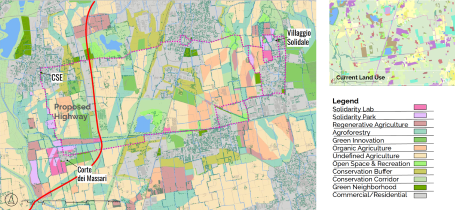
The continuing summer design work has also led to a broader, regional vision: a solidarity and agroecology district that integrates agriculture, recreation, and conservation through a shared ecological and social framework. At the center of this vision is the Tarantasio Trail, a proposed system of bike and walking paths that will connect nearby communities to heritage sites and ecological nodes. The trail network aims to create access to the fontanili landscapes, organic farms, and educational and solidarity-driven institutions in a way that supports both ecological continuity and human well-being.
The Tarantasio Trail represents an expanded vision of solidarity, one that moves beyond the scale of a single community toward a regional fabric of connection and care that will promote:
- Active mobility, encouraging physical recreation and sustainable transportation;
- Agroecology and organic farming, linking production landscapes with educational and therapeutic activities;
- Ecological conservation, protecting sensitive habitats and waterways; and
- Cultural exchange and learning, connecting communities through shared landscape narratives.
In this vision, the landscape becomes an infrastructure for solidarity, supporting not only mobility and recreation but also the right to landscape access, beauty, and belonging.
Roots in Education and Co-Creation
The Solidarity Landscape Living Lab began in 2022 as a pedagogical experiment inspired by the Open Landscape Academy (OLA), an Erasmus+ partnership focused on landscape democracy and co-creation. Its educational activities have included the creation of the Solidarity Landscape Ambassador Course, a four-module curriculum designed to empower social workers, community leaders, and educators to apply landscape thinking and nature-based interventions to strengthen inclusion, capabilities, and well-being.
Each module, including The Landscape and I, Solidarity Landscapes, Healing Landscapes, and Agroecology, combines theory with reflective practice, drawing, meditation, solidarity mapping, and field experiments in ecological stewardship. A survey was conducted to assess course learning outcomes. One participant stated that the experience changed her perspective, explaining that “this is a new way of understanding the landscape - not just maintained as a lawn, but expressing nature’s full capacity and richness.” Another class participant stated that he “always believed in these topics… I know nature is healing, but I am glad to know that there are scientific studies about this, so I can share and apply them.”
The Living Lab extends this educational model into real-world contexts. By linking UMD students with European communities and organizations, it offers immersive experiences that integrate design research, participatory methods, and systems thinking to address real challenges in real communities. Reflecting on their workshop experiences, one student commented, “This allowed me the chance to practice collaborating with a client. It gave me the opportunity to see what skills I would need to improve on to be an effective professional.”
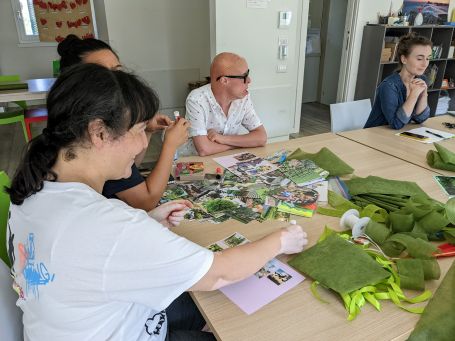
After an impromptu co-design activity with new project partners during a visit to a community garden, one UMD student reported, “I had learned a lot about participatory design and seen a lot of case studies… but hadn’t been able to apply any of those design theories and practices with actual residents. [This experience] helped teach me how to navigate the co-creation process, where the community members should be the ones in the driver's seat. As landscape architecture students, we are always the ones driving design intentions, but in reality, that isn’t how the process should work. I wouldn’t have had that experience in studio, so I was grateful to learn from the co-creation activity.”
Looking Ahead
In 2026 and beyond, the Solidarity Landscape Living Lab aims to deepen its partnerships and research outputs. Planned activities include:
- Developing detailed design, implementation, and management plans for the Villaggio Solidale expansion.
- Advancing the Tarantasio Trail through community engagement and environmental analysis.
- Publishing and sharing the Living Lab’s methods as a model for agroecology-driven regional planning; and
- Creating new teaching modules and open-sourced educational materials for use across landscape architecture, community development, and environmental design and stewardship programs.
In the spirit of solidarity and participatory action research, the work of the Solidarity Landscape Living Lab continues to expand and evolve, empowering our students and community partners to steward the landscape and create meaningful change together.
To learn more about the Solidarity Landscape Living Lab and explore its outcomes, please visit: https://go.umd.edu/Solidaritylandscape
